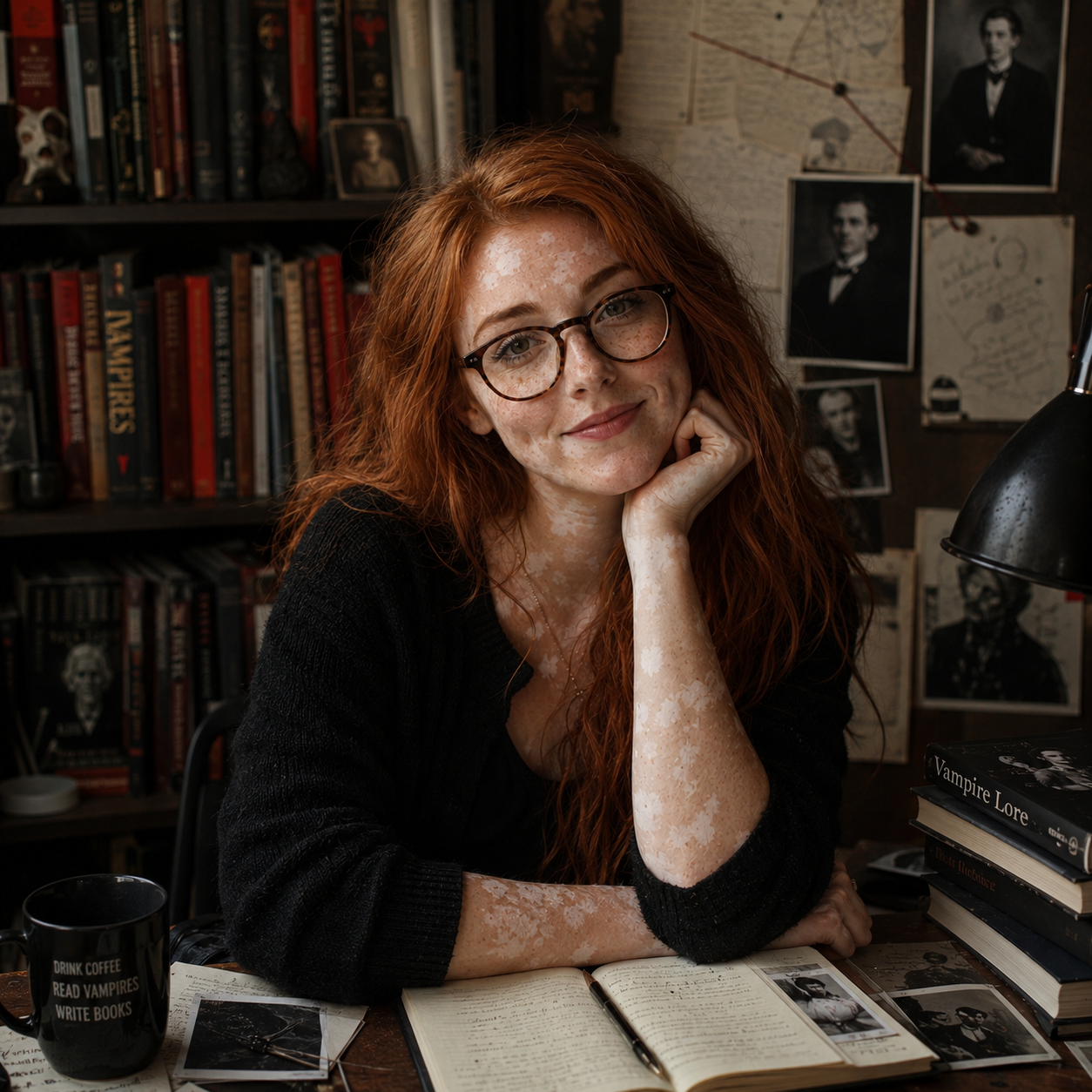
Vampire romance has given us a persuasive visual language for obsession. He has watched her from a rooftop. He knows which window is hers. He can identify her footsteps in a crowded hall, remembers a remark she made three winters ago, and keeps artifacts from every era in which she unknowingly existed near him. The camera calls this devotion because the lighting is excellent and he has cheekbones sharp enough to commit a misdemeanor.
But attention is not knowledge. Surveillance is not intimacy. A man who has watched a woman for a century may know the color of the scarf she wore on a Tuesday without knowing the first useful thing about her: what she wants when nobody is arranging a dramatic rescue around her.
That is where vampire romance becomes most revealing. The immortal admirer embodies a familiar fantasy: to be noticed completely, even in the details we assume the world misses. The better stories refuse to confuse being intensely observed with being genuinely seen.
Obsession collects evidence; love makes room
An obsessive vampire is often an archivist. He knows her schedule, habits, favorite song, old griefs, weak points, the names of people who hurt her, and perhaps an alarming amount about her blood chemistry. He can recite these facts as proof that his fixation is profound.
They prove he has been paying attention. They do not prove he understands her.
To know someone is not to possess a detailed file. It is to let her account of herself matter. It means accepting that she may change her mind, leave town, fall out of love, choose an ordinary life, or prefer an answer inconvenient to the grand story he has written in his head. It means asking rather than assuming, listening rather than decoding, and accepting that people remain inconveniently alive to their own revisions.
This matters especially with immortals. Centuries can make a vampire patient, cultivated, and devastatingly good at selecting a coat. They can also make him dangerously certain that pattern recognition is wisdom. He has seen wars, empires, fashions, and a thousand versions of human self-deception. Fine. He still does not get to tell one particular woman what she feels because he has known “her type” for three hundred years.
A vampire who says, “I know you better than you know yourself,” should be met with the ancient and sacred response: “That is not the compliment you think it is.”
Why the all-seeing monster appeals
We should be honest about why this trope works. Modern life contains a great deal of low-grade invisibility. People are busy, distracted, half-present. They forget what you said last week. They answer the practical part of your message and glide past the emotional one. A beautiful, dangerous creature who notices everything can feel less like a threat than relief.
The fantasy is not necessarily that he knows where she is at all times. The fantasy is that someone finally understands she is not interchangeable.
That longing deserves respect. It also deserves better writing than a man lurking outside her bedroom and calling it destiny.
The strongest vampire romances turn heightened attention into earned intimacy. The vampire notices, yes, but does not treat what he notices as a claim on her. If he learns she hates surprises, he stops ambushing her with roses at midnight. If he recognizes her fear, he does not exploit it to become indispensable. If he wants to protect her, he asks what protection would actually look like in her life.
This is not less romantic. It is more difficult, which is why it carries weight. Anyone can memorize a woman’s favorite flower. The real test is whether he can hear, “Please do not send flowers to my office,” without treating it as a personal tragedy worthy of thunder, broken glass, and a self-pitying piano score.
When his gaze makes her disappear
There is also a craft problem when a story presents the heroine mostly through the vampire’s hungry attention. She becomes a collection of exquisite observations: the curve of her throat, the pulse at her wrist, her scent in rain, the sound of her laugh, the particular grief in her eyes. All atmospheric. None of it necessarily gives her a life.
If the story only tells us how she appears to him, she becomes an exhibit inside his loneliness. He may worship her, but worship is not always generous. It can freeze a woman at the version of herself that best serves someone else’s emotional need.
A heroine becomes real when she has desires that cannot be reduced to his desire for her. Maybe she wants a career that takes her away from his city. Maybe she has friendships he finds inconvenient, a family history she interprets differently, or ambitions that make his offered eternity look like a very elegant cage. Maybe she is not secretly waiting for a dangerous man to explain why her life has felt incomplete. Imagine.
Her ability to leave is essential to the romance, not a defect in it. As “Boundaries Are Hotter Than Begging” observes, access is not automatic. The threshold matters. So does the woman who decides whether it opens.
The knowledge test is what he does with no
Every vampire romance eventually has to answer a basic question: what happens when she refuses him?
An obsessive character treats her no as a clue. She is frightened, confused, testing him, protecting him from herself, or trying to deny fate. He reads resistance as text requiring his superior interpretation. It keeps tension high on the page, but it is also the logic of someone who cannot imagine another person’s boundary as real unless it agrees with his appetite.
A loving character treats no as information. It may hurt him. It may change the future he wanted. It may expose the fact that his grand immortal confidence was mostly expensive tailoring over terror. But he accepts it. He does not recruit her friends, manufacture danger, withhold crucial information, or turn “I cannot live without you” into a responsibility she must solve.
This is not an argument for sanding every vampire down into a polite supernatural boyfriend who brings soup and attends communication workshops. Monsters should retain their danger. The point is that danger needs moral shape. A vampire may struggle with hunger, jealousy, old violence, and the ugly reflex to control what he fears losing. What makes him worthy of romance is not the absence of those impulses. It is the discipline not to make them her burden.
Possessiveness photographs well. So do hand-on-the-wall scenes, low voices, jealousy, and beautiful men having terrible emotional weather. But control does not become loving merely because the man doing it is gorgeous, wounded, or undead. “Stop Calling Possessiveness Passion” makes the necessary distinction: wanting someone intensely is not the same as trying to turn her life into a locked room.
Let the vampire be surprised
The most romantic thing an ancient vampire can say is not “I have waited for you.” It may be “I was wrong about you.”
That sentence requires humility, which is difficult for creatures accustomed to being the oldest, strongest, richest, best-dressed person in every room. It admits that the heroine is not an object he successfully deciphered before the first kiss. Her interior life can interrupt his assumptions. She can surprise him without becoming a manic pixie lesson in spontaneity. She can be unknowable in the healthy sense: not secretive as punishment, but sovereign.
Good romance preserves that sovereignty even at its most intimate. The characters can share histories, bodies, risks, and the appalling logistics of eternal life without becoming possessions of each other’s gaze. The vampire does not win because he watched longest. He earns his place because he can stand close, pay attention, tell the truth, and still leave the door unlocked.
Love is not a private museum
Vampires are excellent at making preservation look romantic. They keep letters, portraits, lockets, houses, grudges, and names. Their fear of loss is understandable: when you live forever, memory may be the only graveyard you can tend with your own hands.
But romance is not preservation. To love someone is not to place her behind glass at the version of herself that first fascinated you. It is to encounter her again as she changes, and to accept that some changes may lead her away from you.
That is the distinction vampire stories are uniquely equipped to make. Obsession says, “I have watched you for a century.” Love says, “I see you now. What do you want?” One is a claim. The other is an opening. Only one of them deserves to be invited inside.